
Trump’s threats to pull out of NATO have galvanized Europeans to start building militaries independent of the U.S. So has Putin’s invasion of Ukraine. The invasion has also led Ukraine to build one of the world’s most sophisticated armies, with more advanced drone technology than the U.S. – tech it’s now sharing with European allies. The result is a messy entity called “Europe” with enormous military potential, not to mention the world’s second largest economy. That’s starting to sound like a world power.
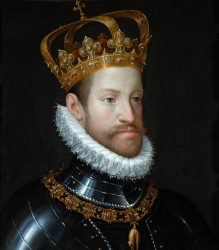
Holy Roman Emperor Charles V (1500–1558)
By “Europe,” I mean the whole subcontinent, minus Russia, Belarus, and the Caucasus nations (which fall into a different geo-political zone). Many would say this region can’t be a world power because it lacks unity and a federal structure. And Europe’s divisions do limit its reach. But European history offers a model for a messy, decentralized state that still reigned as a great power: the original German empire, a.k.a. the Holy Roman Empire.
Holy Roman Giant
In 962 CE, Pope John XII put an imperial crown on Germany’s King Otto I, naming him Emperor of the Romans. Thus began a state we now call the Holy Roman Empire. (Some historians date the empire’s birth to the similar coronation of Charlemagne in 800. Either way, don’t confuse it with the actual, ancient Roman Empire.)
This giant realm covered most of Central Europe for more than 700 years. Its territories included Germany, Austria, Switzerland, the Czech Republic, Belgium, the Netherlands, and various parts of Poland, Slovenia, Slovakia, Denmark, Sweden, Italy, and France. And its influence extended much further, into allied states to the east and west. Imperial power continued through the 1600s, and the empire did not formally dissolve until 1806.
Nationalism and Centralization … Everywhere Else
The nations of Western Europe began to centralize in the 1400s, taking power from nobles and clergy and putting it in the hands of kings – or of national assemblies in the case of the Netherlands and (eventually) England and Scotland. Passionate national loyalties arose around the same time in England and, later, in other European lands. These trends, centralization and nationalism, gave rise to western states so strong that the largest eventually conquered most of Asia, Africa, and the Americas.

The Holy Roman Empire in 1356 (red borders)
Centralization and nationalism, however, largely bypassed the Holy Roman Empire. It retained much of its medieval feudal structure, with dukes, bishops, and other lords ruling a hodge-podge of territories as vassals of the emperor. The reasons are complex, but they include a series of battles against the Pope during the 1070s, which the emperor lost, weakening imperial power, along with the Wars of the Reformation, which repeatedly devastated the empire between about 1520 and 1648.
A Different Kind of Great Power
Some historians call the empire weak because it never centralized into a nation-state. But weak realms don’t tend to last, and the Holy Roman Empire did – for more than seven centuries. For most of that time, furthermore, it was Europe’s most populous state, and the emperor reigned as its leading monarch. He did lack the centralized power the national kings eventually wielded, but he could coordinate cooperative defense with his vassals. In fact, for centuries the empire’s armies gave Europe its primary protection against enemies from the east, including the Magyar barbarians (900s) and the Ottoman Empire (1500s-1600s).
The Holy Roman Empire, furthermore, did more than just rule its member-states. It provided councils, courts, and other government structures. Member-states used those agencies to cooperate on trade, defense, and other projects.
On top of all that, the empire wielded power over states beyond its frontiers, often through marriage alliances and inheritance. Emperor Charles V, for instance, inherited the entire Kingdom of Spain in 1516, which of course brought along vast wealth from the Spanish empire in the Americas.
The New Empire
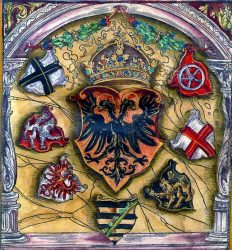
The Holy Roman Emperor’s coat of arms and those of his greatest vassals, the electors
Modern Europe isn’t a nation-state either. At its heart lies the European Union, which also isn’t a nation-state. The EU controls only a small part of its members’ revenues and very little of their military resources. But it can coordinate collective action, including defense. The EU also has significant influence over non-members, like Ukraine and Great Britain. In other words, the European Union has the power to coordinate diverse European states, just as the Holy Roman Empire did. We’ve seen that power on display since Russia invaded Ukraine in 2022, with the EU playing a central role in coordinating aid to Ukraine and sanctions on Russia. And we see that power growing today, as the Europeans lose faith in American defense and start to build stronger militaries.
The EU governs more than 449 million people, while Europe itself (as defined above) has 589 million. That’s more than any nation except China and India. And the EU’s gross domestic product exceeded $19 trillion in 2024, while Europe itself had $25 trillion. That puts Europe above China, at 18.7 trillion, trailing only the U.S. (at $28.8 trillion). Europe also has the most sophisticated drone force in the world, via the Ukrainian army. And the Ukrainians have agreed to set up drone factories in the UK, Germany, Norway, Lithuania, and Finland. Plus, Europe has nuclear weapons, in the hands of Britain and France. With those numbers and military assets, Europe could wield great power status.
Until the last couple centuries, no one considered the nation-state the only or even the best structure for a powerful realm. The greatest states were empires, sometimes loosely governed and coordinated. A European “empire” would be looser than most, but that might not be fatal. Europe could revive the complex, decentralized, consensus-based power of the Holy Roman Empire.
FYI, I’m writing a novel set in a world based on the Holy Roman Empire! It’s tentatively called A Lawyer for Dukes and Drifters. Please click here and sign up to be informed of publication dates.
© 2026 by David W. Tollen. All rights reserved.
Illustrations:
- The Holy Roman Emperor Charles V , by Juan Pantoja de la Cruz (Style of)
- Map of the Holy Roman Empire in 1356, by Cameron Pauley, provided through Wikimedia Commons and licensed under Creative Commons Attribution-Share Alike 4.0 International
- Imperial coat of arms, Holy Roman Empire, with the coats of arms of the prince-electors: Cologne, Mainz, Trier, Bohemia, Palatinate, Brandenburg, Saxony, from a 1545 armorial printed in Frankfurt
0 Comments